
Compare top email automation platforms for 2026. Find the right tool for your team's deliverability, segmentation, and ROI needs with expert recommendations.
Choosing the wrong email marketing automation tool is expensive. You pay for features you never use, fight a clunky interface during your busiest campaigns, and watch deliverability quietly decline. The right choice drives higher open rates, better conversions, and a channel that actually works. The wrong one means wasted money, poor deliverability, and hours lost to friction.
The data backs the urgency. Email marketing delivers a return of between $36 and $42 for every $1 spent, the highest ROI of any digital marketing channel. By comparison, paid search returns $2 per $1, social advertising $2.80, and display ads $1.35. But that return depends heavily on the platform doing the work.
This guide covers the best email marketing automation tools in 2026, who each one is built for, what makes it stand out, and where it falls short.
Key Takeaways
Automated emails generate 16x more revenue per send than manual campaigns ($2.87 vs. $0.18 per email).
In 2024, automated emails drove 37% of all email-generated sales despite accounting for just 2% of email volume.
For most small businesses, ActiveCampaign is the top-rated marketing automation platform for depth and flexibility.
Klaviyo remains the default recommendation for ecommerce brands under $1B in GMV, with best-in-class Shopify integration and 2026 AI features for replenishment and winback flows.
By late 2026, 61% of enterprise email programs will use AI for at least one element of campaign creation, making AI-native features a key selection criterion.
Why Email Automation Matters More Than Ever in 2026
In 2026, marketers are using automation to improve timing, personalize customer journeys, trigger lifecycle messaging, and create more relevant experiences at scale. This is no longer a "nice to have."
Automated workflows generate 30x higher returns compared to one-off email campaigns. And the gap is widening as AI-powered tools get smarter about timing and personalization. Companies using AI-driven email strategies see up to 41% more revenue than those using traditional batch-and-blast sends.
In 2024, 62% of teams took two weeks or more to send a single email. By 2026, 76% deploy within three days, largely because automation and AI tools have compressed the production cycle. The platforms you choose determine how quickly you can act on your data.
Choosing the wrong email marketing automation tool is expensive. You pay for features you never use, fight a clunky interface during your busiest campaigns, and watch deliverability quietly decline. The right choice drives higher open rates, better conversions, and a channel that actually works. The wrong one means wasted money, poor deliverability, and hours lost to friction.
The data backs the urgency. Email marketing delivers a return of between $36 and $42 for every $1 spent, the highest ROI of any digital marketing channel. By comparison, paid search returns $2 per $1, social advertising $2.80, and display ads $1.35. But that return depends heavily on the platform doing the work.
This guide covers the best email marketing automation tools in 2026, who each one is built for, what makes it stand out, and where it falls short.
Key Takeaways
Automated emails generate 16x more revenue per send than manual campaigns ($2.87 vs. $0.18 per email).
In 2024, automated emails drove 37% of all email-generated sales despite accounting for just 2% of email volume.
For most small businesses, ActiveCampaign is the top-rated marketing automation platform for depth and flexibility.
Klaviyo remains the default recommendation for ecommerce brands under $1B in GMV, with best-in-class Shopify integration and 2026 AI features for replenishment and winback flows.
By late 2026, 61% of enterprise email programs will use AI for at least one element of campaign creation, making AI-native features a key selection criterion.
Why Email Automation Matters More Than Ever in 2026
In 2026, marketers are using automation to improve timing, personalize customer journeys, trigger lifecycle messaging, and create more relevant experiences at scale. This is no longer a "nice to have."
Automated workflows generate 30x higher returns compared to one-off email campaigns. And the gap is widening as AI-powered tools get smarter about timing and personalization. Companies using AI-driven email strategies see up to 41% more revenue than those using traditional batch-and-blast sends.
In 2024, 62% of teams took two weeks or more to send a single email. By 2026, 76% deploy within three days, largely because automation and AI tools have compressed the production cycle. The platforms you choose determine how quickly you can act on your data.
If you want to understand which specific tactics work inside these platforms, the guide on email marketing automation tips covers nine proven ways to save time and improve performance.
How to Evaluate the Best Email Marketing Automation Tools
Before reviewing platforms, you need to know what criteria actually separate good tools from great ones. The most meaningful evaluation factors are deliverability (sender reputation, SPF/DKIM/DMARC support), automation depth (trigger logic, conditional branching, multi-step sequences), ease of use, pricing transparency, integrations, and support quality.
Three additional factors matter in 2026 specifically:
AI capabilities: Advanced AI adopters are 75% more likely to achieve ROIs above 45:1. The teams pulling ahead apply AI to segmentation, subject line testing, and send-time optimization across every campaign, not just content generation.
Scalability: Whether you are sending to 500 people or 500,000, the tool should grow with you through flexible pricing, features that expand, and the ability to plug into your broader tech stack.
Pricing model fit: Some tools charge by contacts, others by email volume. The right model depends on how frequently you send and how large your list is relative to your send frequency.
The Best Email Marketing Automation Tools in 2026
1. ActiveCampaign: Best for Deep Automation (B2B and SaaS)
No other platform matches ActiveCampaign's combination of automation sophistication, CRM integration, deliverability, and pricing. It is the top pick for businesses wanting powerful marketing automation without enterprise pricing.
Its visual workflow builder is the most intuitive tested, letting you create complex branching sequences without code. The built-in CRM eliminates the need for a separate tool, and deliverability consistently ranks among the highest at 96% inbox placement.
The 900+ pre-built automation templates are a genuine time-saver. Instead of building flows from scratch, you can import a template, customize the triggers, and go live in minutes. Marketing teams using ActiveCampaign save an average of 10 hours weekly across tasks like campaign building, content creation, and lead follow-up.
Best for: B2B teams, SaaS companies, and marketers who need sophisticated behavioral automation with a built-in CRM.
Pricing: Starts at $19/month for 1,000 contacts, with transparent pricing and no hidden fees.
Watch out for: List management feels dated and reporting lags HubSpot.
2. Klaviyo: Best for Ecommerce
If you want to understand which specific tactics work inside these platforms, the guide on email marketing automation tips covers nine proven ways to save time and improve performance.
How to Evaluate the Best Email Marketing Automation Tools
Before reviewing platforms, you need to know what criteria actually separate good tools from great ones. The most meaningful evaluation factors are deliverability (sender reputation, SPF/DKIM/DMARC support), automation depth (trigger logic, conditional branching, multi-step sequences), ease of use, pricing transparency, integrations, and support quality.
Three additional factors matter in 2026 specifically:
AI capabilities: Advanced AI adopters are 75% more likely to achieve ROIs above 45:1. The teams pulling ahead apply AI to segmentation, subject line testing, and send-time optimization across every campaign, not just content generation.
Scalability: Whether you are sending to 500 people or 500,000, the tool should grow with you through flexible pricing, features that expand, and the ability to plug into your broader tech stack.
Pricing model fit: Some tools charge by contacts, others by email volume. The right model depends on how frequently you send and how large your list is relative to your send frequency.
The Best Email Marketing Automation Tools in 2026
1. ActiveCampaign: Best for Deep Automation (B2B and SaaS)
No other platform matches ActiveCampaign's combination of automation sophistication, CRM integration, deliverability, and pricing. It is the top pick for businesses wanting powerful marketing automation without enterprise pricing.
Its visual workflow builder is the most intuitive tested, letting you create complex branching sequences without code. The built-in CRM eliminates the need for a separate tool, and deliverability consistently ranks among the highest at 96% inbox placement.
The 900+ pre-built automation templates are a genuine time-saver. Instead of building flows from scratch, you can import a template, customize the triggers, and go live in minutes. Marketing teams using ActiveCampaign save an average of 10 hours weekly across tasks like campaign building, content creation, and lead follow-up.
Best for: B2B teams, SaaS companies, and marketers who need sophisticated behavioral automation with a built-in CRM.
Pricing: Starts at $19/month for 1,000 contacts, with transparent pricing and no hidden fees.
Watch out for: List management feels dated and reporting lags HubSpot.
2. Klaviyo: Best for Ecommerce
Klaviyo is purpose-built for ecommerce. Its Shopify integration syncs product catalogs, purchase history, and browsing behavior in real time, enabling hyper-targeted campaigns that generic platforms cannot replicate. Revenue attribution is baked into every report, and predictive analytics forecast customer lifetime value, churn risk, and optimal next-purchase timing.
Klaviyo's advanced segmentation lets users create highly specific audience groups based on behavior, purchase history, and engagement. Its AI-powered predictive analytics provide insights into metrics like customer lifetime value, churn risk, and expected next order date.
For deeper context on how to translate these tools into results, see the guide on ecommerce email marketing strategies.
Best for: Shopify and WooCommerce stores that want revenue-attributed automation and predictive segmentation.
Pricing: Free up to 250 contacts. Paid plans scale by contact count and can get expensive at larger list sizes.
Watch out for: Klaviyo's extensive features present a steep learning curve for new users, making it less accessible without prior email marketing experience.
3. HubSpot: Best for CRM-First Teams
For most scaling B2B, SaaS, and services teams, HubSpot's Marketing Hub is the most complete option. The automation depth, native CRM, AI tools, and usable free tier make it the lowest-risk starting point for teams that expect to grow into more sophisticated programs.
HubSpot's email tool is at its best when used alongside the HubSpot CRM, which is free for unlimited users and stores up to 1 million contacts. The combination gives you a complete view of the customer journey from first email open to closed deal without switching platforms.
Best for: B2B teams, agencies, and enterprises that want email, CRM, landing pages, and reporting unified in one platform.
Pricing: Free plan available. Paid tiers scale significantly. Pricing increases quickly as you scale beyond the free or starter plan.
Watch out for: HubSpot can feel overwhelming for small businesses that only need email automation, and some advanced features are locked behind higher-tier plans.
4. Brevo: Best for Cost-Effective Multi-Channel Marketing
Brevo (formerly Sendinblue) is a multi-channel platform focused on making SMS and email marketing accessible and affordable for small and mid-sized businesses. Its send-based pricing model is a genuine differentiator for businesses with large contact lists but moderate sending frequency.
Brevo allows unlimited contacts on most plans and charges based on monthly email volume. This benefits businesses with large databases who send infrequently or segment heavily.
Brevo brings together tools for email, SMS, WhatsApp, and live chat. The platform includes built-in AI (Aura AI) supporting content creation, campaign automation, and audience segmentation.
Best for: Businesses with large contact lists and lower send frequency, or those needing multi-channel marketing at a competitive price point.
Klaviyo is purpose-built for ecommerce. Its Shopify integration syncs product catalogs, purchase history, and browsing behavior in real time, enabling hyper-targeted campaigns that generic platforms cannot replicate. Revenue attribution is baked into every report, and predictive analytics forecast customer lifetime value, churn risk, and optimal next-purchase timing.
Klaviyo's advanced segmentation lets users create highly specific audience groups based on behavior, purchase history, and engagement. Its AI-powered predictive analytics provide insights into metrics like customer lifetime value, churn risk, and expected next order date.
For deeper context on how to translate these tools into results, see the guide on ecommerce email marketing strategies.
Best for: Shopify and WooCommerce stores that want revenue-attributed automation and predictive segmentation.
Pricing: Free up to 250 contacts. Paid plans scale by contact count and can get expensive at larger list sizes.
Watch out for: Klaviyo's extensive features present a steep learning curve for new users, making it less accessible without prior email marketing experience.
3. HubSpot: Best for CRM-First Teams
For most scaling B2B, SaaS, and services teams, HubSpot's Marketing Hub is the most complete option. The automation depth, native CRM, AI tools, and usable free tier make it the lowest-risk starting point for teams that expect to grow into more sophisticated programs.
HubSpot's email tool is at its best when used alongside the HubSpot CRM, which is free for unlimited users and stores up to 1 million contacts. The combination gives you a complete view of the customer journey from first email open to closed deal without switching platforms.
Best for: B2B teams, agencies, and enterprises that want email, CRM, landing pages, and reporting unified in one platform.
Pricing: Free plan available. Paid tiers scale significantly. Pricing increases quickly as you scale beyond the free or starter plan.
Watch out for: HubSpot can feel overwhelming for small businesses that only need email automation, and some advanced features are locked behind higher-tier plans.
4. Brevo: Best for Cost-Effective Multi-Channel Marketing
Brevo (formerly Sendinblue) is a multi-channel platform focused on making SMS and email marketing accessible and affordable for small and mid-sized businesses. Its send-based pricing model is a genuine differentiator for businesses with large contact lists but moderate sending frequency.
Brevo allows unlimited contacts on most plans and charges based on monthly email volume. This benefits businesses with large databases who send infrequently or segment heavily.
Brevo brings together tools for email, SMS, WhatsApp, and live chat. The platform includes built-in AI (Aura AI) supporting content creation, campaign automation, and audience segmentation.
Best for: Businesses with large contact lists and lower send frequency, or those needing multi-channel marketing at a competitive price point.
Pricing: Brevo's free forever plan allows up to 100,000 contacts and includes automation, 40+ email templates, signup forms, and up to 9,000 emails per month.
Watch out for: EmailToolTester's latest deliverability tests scored Brevo at 88.3%, placing it 8th out of 15 tools tested, which trails ActiveCampaign and Mailchimp.
5. Omnisend: Best Ecommerce Platform for SMBs
Omnisend is a marketing automation platform tailored for ecommerce businesses, combining email and SMS marketing into one system. It offers customizable templates, real-time audience segmentation, and automation workflows like welcome messages, abandoned cart recovery, and post-purchase follow-ups.
Omnisend targets the SMB ecommerce segment with a cleaner onboarding experience and lower price point than Klaviyo. It is a strong choice for stores under $250K in annual revenue.
Best for: Small to mid-sized ecommerce stores that want multichannel automation (email + SMS) without Klaviyo's pricing complexity.
Watch out for: Predictive models are shallow and analytics depth trails Klaviyo noticeably at scale.
6. MailerLite: Best Free Option for Small Businesses
MailerLite's automation tools stand out as a major strength for its price. Welcome emails, abandoned cart emails, and audience segmentation are all included. You can build relatively advanced workflows with multiple triggers and actions, and the automation editor is simple enough for beginners.
The free plan includes 1,000 subscribers and 12,000 emails per month. The main difference between MailerLite and Mailchimp is value for money. MailerLite wins clearly, offering more contacts, unlimited emails, and lower costs at comparable feature levels.
Best for: Solopreneurs, creators, and small businesses that want a capable, clean platform without a steep learning curve or high monthly cost.
Watch out for: This is built for small to midsize companies, not for complex enterprise automations.
7. GetResponse: Best for Conversion Funnels and Webinars
GetResponse has evolved from a simple email tool into one of the most feature-complete marketing platforms available. It uniquely bundles webinar hosting, website building, landing pages, and conversion funnels alongside email marketing.
GetResponse consistently beats Mailchimp on pricing when automation is factored in. Its Email Marketing plan starts at $15.58/month for 1,000 contacts and includes unlimited emails, autoresponders, landing pages, and a website builder, features Mailchimp gates behind its Standard or Premium tiers.
Best for: Coaches, consultants, course creators, and B2B lead generation teams that want email automation, webinars, and sales funnels in one platform.
Watch out for: Marketing automation is solid but less granular than ActiveCampaign.
8. Mailchimp: Best for Simplicity and Integrations
Mailchimp remains the most recognized email marketing name globally, with over 11 million users. Its ecosystem of 800+ native integrations from Shopify to Salesforce is unmatched.
Pricing: Brevo's free forever plan allows up to 100,000 contacts and includes automation, 40+ email templates, signup forms, and up to 9,000 emails per month.
Watch out for: EmailToolTester's latest deliverability tests scored Brevo at 88.3%, placing it 8th out of 15 tools tested, which trails ActiveCampaign and Mailchimp.
5. Omnisend: Best Ecommerce Platform for SMBs
Omnisend is a marketing automation platform tailored for ecommerce businesses, combining email and SMS marketing into one system. It offers customizable templates, real-time audience segmentation, and automation workflows like welcome messages, abandoned cart recovery, and post-purchase follow-ups.
Omnisend targets the SMB ecommerce segment with a cleaner onboarding experience and lower price point than Klaviyo. It is a strong choice for stores under $250K in annual revenue.
Best for: Small to mid-sized ecommerce stores that want multichannel automation (email + SMS) without Klaviyo's pricing complexity.
Watch out for: Predictive models are shallow and analytics depth trails Klaviyo noticeably at scale.
6. MailerLite: Best Free Option for Small Businesses
MailerLite's automation tools stand out as a major strength for its price. Welcome emails, abandoned cart emails, and audience segmentation are all included. You can build relatively advanced workflows with multiple triggers and actions, and the automation editor is simple enough for beginners.
The free plan includes 1,000 subscribers and 12,000 emails per month. The main difference between MailerLite and Mailchimp is value for money. MailerLite wins clearly, offering more contacts, unlimited emails, and lower costs at comparable feature levels.
Best for: Solopreneurs, creators, and small businesses that want a capable, clean platform without a steep learning curve or high monthly cost.
Watch out for: This is built for small to midsize companies, not for complex enterprise automations.
7. GetResponse: Best for Conversion Funnels and Webinars
GetResponse has evolved from a simple email tool into one of the most feature-complete marketing platforms available. It uniquely bundles webinar hosting, website building, landing pages, and conversion funnels alongside email marketing.
GetResponse consistently beats Mailchimp on pricing when automation is factored in. Its Email Marketing plan starts at $15.58/month for 1,000 contacts and includes unlimited emails, autoresponders, landing pages, and a website builder, features Mailchimp gates behind its Standard or Premium tiers.
Best for: Coaches, consultants, course creators, and B2B lead generation teams that want email automation, webinars, and sales funnels in one platform.
Watch out for: Marketing automation is solid but less granular than ActiveCampaign.
8. Mailchimp: Best for Simplicity and Integrations
Mailchimp remains the most recognized email marketing name globally, with over 11 million users. Its ecosystem of 800+ native integrations from Shopify to Salesforce is unmatched.
Mailchimp's trigger options have expanded recently. A new Site Tracking Pixel (Standard plans and above, launched February 2026) lets you build automations around what visitors actually browse on your site.
Best for: Teams already embedded in the Mailchimp ecosystem or those who prioritize ease of use and a large integration marketplace.
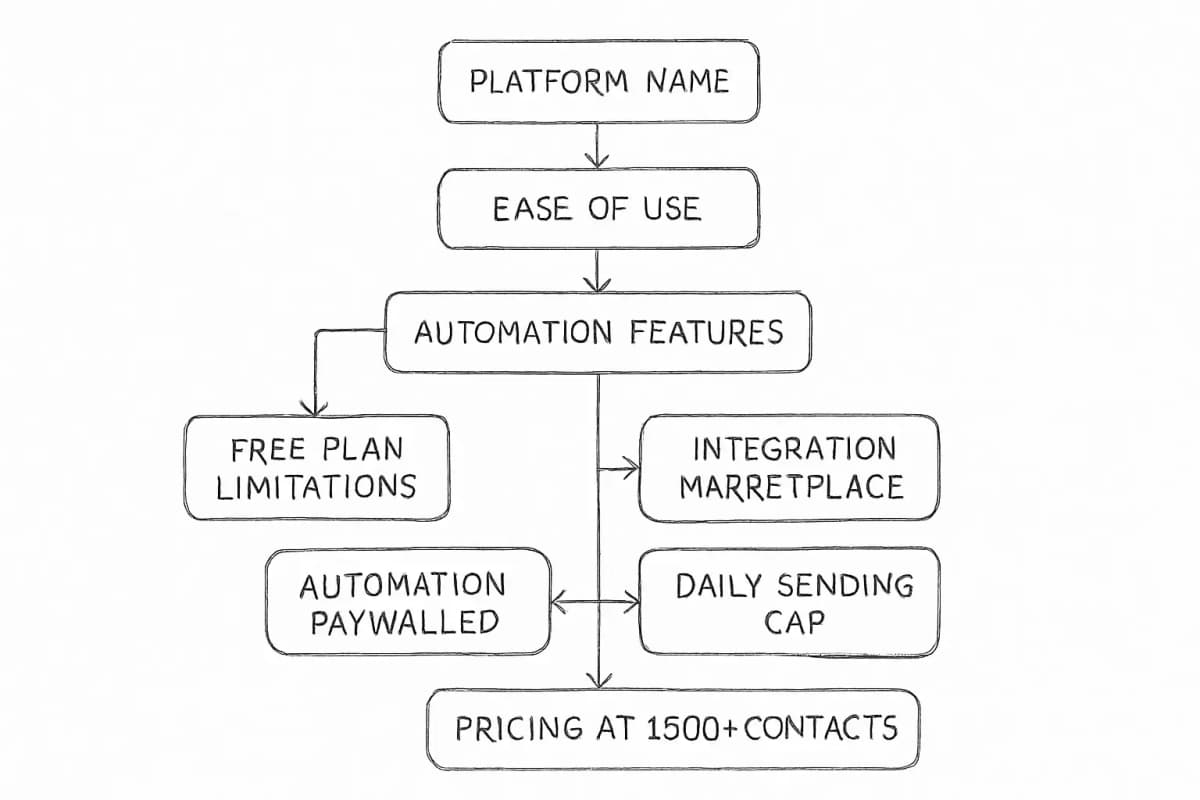
Watch out for: Its free plan has been significantly scaled back. Automation is now paywalled, the daily sending cap is restrictive, and pricing scales steeply as your list grows past 1,500 contacts.
How to Choose the Right Platform for Your Business
There is no single best tool. The right platform depends entirely on your use case, team size, and budget. Here is a practical decision framework:
For advanced automation (B2B/SaaS): ActiveCampaign or HubSpot
For ecommerce (Shopify/WooCommerce): Klaviyo for larger stores, Omnisend for budget-conscious multichannel
For multi-channel on a budget: Brevo, particularly if you have a large list with lower send frequency
For small businesses just starting out: MailerLite or GetResponse
For conversion funnels and webinars: GetResponse
For simplicity and integration breadth: Mailchimp
Some tools do email sequences well but fall apart on segmentation. Others promise full automation but gate the features you actually need behind enterprise pricing. And plenty look similar on a feature checklist until you are mid-implementation and realize the CRM does not sync the way you assumed.
Test your top two choices with real campaigns before committing. Most platforms offer free trials or free plans. Proper list segmentation will also amplify the results from whichever platform you choose.
The Role of AI in Email Automation in 2026
AI has moved from differentiator to baseline expectation across most platforms. Generative AI is the most impactful AI use in email marketing, cited by 22% of marketers, ahead of personalizing content (15%), campaign analysis (15%), and improving deliverability (12%).
AI-generated subject lines outperform human-written ones by 26% for open rates on average. Combined with dynamic send-time optimization, the total lift reaches roughly 40%.
Mailchimp's trigger options have expanded recently. A new Site Tracking Pixel (Standard plans and above, launched February 2026) lets you build automations around what visitors actually browse on your site.
Best for: Teams already embedded in the Mailchimp ecosystem or those who prioritize ease of use and a large integration marketplace.
Watch out for: Its free plan has been significantly scaled back. Automation is now paywalled, the daily sending cap is restrictive, and pricing scales steeply as your list grows past 1,500 contacts.
How to Choose the Right Platform for Your Business
There is no single best tool. The right platform depends entirely on your use case, team size, and budget. Here is a practical decision framework:
For advanced automation (B2B/SaaS): ActiveCampaign or HubSpot
For ecommerce (Shopify/WooCommerce): Klaviyo for larger stores, Omnisend for budget-conscious multichannel
For multi-channel on a budget: Brevo, particularly if you have a large list with lower send frequency
For small businesses just starting out: MailerLite or GetResponse
For conversion funnels and webinars: GetResponse
For simplicity and integration breadth: Mailchimp
Some tools do email sequences well but fall apart on segmentation. Others promise full automation but gate the features you actually need behind enterprise pricing. And plenty look similar on a feature checklist until you are mid-implementation and realize the CRM does not sync the way you assumed.
Test your top two choices with real campaigns before committing. Most platforms offer free trials or free plans. Proper list segmentation will also amplify the results from whichever platform you choose.
The Role of AI in Email Automation in 2026
AI has moved from differentiator to baseline expectation across most platforms. Generative AI is the most impactful AI use in email marketing, cited by 22% of marketers, ahead of personalizing content (15%), campaign analysis (15%), and improving deliverability (12%).
AI-generated subject lines outperform human-written ones by 26% for open rates on average. Combined with dynamic send-time optimization, the total lift reaches roughly 40%.
For a deeper look at how AI is being applied within campaigns, the guide on successful AI-driven email marketing examples shows real-world implementations that drive measurable results.
AI personalization in email marketing has moved from novelty to necessity. Platforms that offer AI-generated subject lines, predictive send times, and dynamic content blocks are no longer cutting-edge; they are table stakes. The difference between platforms now lies in execution depth, not whether AI exists.
What to Set Up First After Choosing Your Platform
Once you have chosen a platform, the highest-ROI automations to activate immediately are:
Welcome series: Welcome flows average $2.65 per recipient with top 10% returns of $21.18 per recipient.
Abandoned cart flows: Abandoned cart flows earn $3.65 per recipient on average and can recover a meaningful share of lost revenue.
Behavior-triggered nurture sequences: These fire based on real engagement signals, not arbitrary send schedules.
Review our guide on welcome email sequence best practices to build your first automated flow the right way, and explore email personalization techniques to increase the conversion rate of every sequence you run.
The most effective email marketing campaigns include strategies of segmentation (78%), message personalization (72%), and email automation (71%). These are not separate tactics; they compound. The platform you choose should support all three from day one.
Frequently Asked Questions
What is the best email marketing automation tool for small businesses in 2026?
For small businesses and SMBs on a budget, MailerLite offers the best combination of features and affordability. GetResponse is a strong alternative for businesses that also need landing pages and webinar capability. For small businesses that need deeper automation, ActiveCampaign has been a top pick since 2016.
Which email automation platform has the best ROI for ecommerce?
Klaviyo remains the default recommendation for ecommerce brands under $1B in GMV. The Shopify integration is best in class, predictive analytics work out of the box, and 2026 Klaviyo AI shipped agentic campaign optimization for replenishment and winback flows. Omnisend is the better option for budget-conscious stores that want email and SMS in one platform.
Is ActiveCampaign or HubSpot better for B2B email automation?
ActiveCampaign offers the deepest automation logic for B2B and SaaS teams, with strong behavioral branching, lead scoring, and lifecycle workflows. HubSpot is best for CRM-first teams that need automation, email, and pipeline in one platform, but it comes at the highest cost at scale. If email automation depth is the priority and you are not replacing your CRM, ActiveCampaign delivers more per dollar.
How do I know if my email automation is actually working?
For a deeper look at how AI is being applied within campaigns, the guide on successful AI-driven email marketing examples shows real-world implementations that drive measurable results.
AI personalization in email marketing has moved from novelty to necessity. Platforms that offer AI-generated subject lines, predictive send times, and dynamic content blocks are no longer cutting-edge; they are table stakes. The difference between platforms now lies in execution depth, not whether AI exists.
What to Set Up First After Choosing Your Platform
Once you have chosen a platform, the highest-ROI automations to activate immediately are:
Welcome series: Welcome flows average $2.65 per recipient with top 10% returns of $21.18 per recipient.
Abandoned cart flows: Abandoned cart flows earn $3.65 per recipient on average and can recover a meaningful share of lost revenue.
Behavior-triggered nurture sequences: These fire based on real engagement signals, not arbitrary send schedules.
Review our guide on welcome email sequence best practices to build your first automated flow the right way, and explore email personalization techniques to increase the conversion rate of every sequence you run.
The most effective email marketing campaigns include strategies of segmentation (78%), message personalization (72%), and email automation (71%). These are not separate tactics; they compound. The platform you choose should support all three from day one.
Frequently Asked Questions
What is the best email marketing automation tool for small businesses in 2026?
For small businesses and SMBs on a budget, MailerLite offers the best combination of features and affordability. GetResponse is a strong alternative for businesses that also need landing pages and webinar capability. For small businesses that need deeper automation, ActiveCampaign has been a top pick since 2016.
Which email automation platform has the best ROI for ecommerce?
Klaviyo remains the default recommendation for ecommerce brands under $1B in GMV. The Shopify integration is best in class, predictive analytics work out of the box, and 2026 Klaviyo AI shipped agentic campaign optimization for replenishment and winback flows. Omnisend is the better option for budget-conscious stores that want email and SMS in one platform.
Is ActiveCampaign or HubSpot better for B2B email automation?
ActiveCampaign offers the deepest automation logic for B2B and SaaS teams, with strong behavioral branching, lead scoring, and lifecycle workflows. HubSpot is best for CRM-first teams that need automation, email, and pipeline in one platform, but it comes at the highest cost at scale. If email automation depth is the priority and you are not replacing your CRM, ActiveCampaign delivers more per dollar.
How do I know if my email automation is actually working?
Focus on click rate and revenue attributed to email, not open rates. Apple Mail Privacy Protection now affects roughly 50 to 60% of recorded email opens by pre-loading tracking pixels, inflating open rate data across the industry. Use open rates as a directional signal and lean on click rate and email-attributed revenue as your primary performance benchmarks. Most platforms in this list provide revenue attribution reporting at the campaign and flow level.

No comments yet. Be the first!
Focus on click rate and revenue attributed to email, not open rates. Apple Mail Privacy Protection now affects roughly 50 to 60% of recorded email opens by pre-loading tracking pixels, inflating open rate data across the industry. Use open rates as a directional signal and lean on click rate and email-attributed revenue as your primary performance benchmarks. Most platforms in this list provide revenue attribution reporting at the campaign and flow level.