Your email campaign earns the open, earns the click, and then sends your subscriber somewhere. That "somewhere" decides whether you get a conversion or a bounce. Most marketers invest heavily in email copy and subject lines, but treat the landing page as an afterthought. That gap is where conversions die.
Visitors driven to landing pages by email have the highest average conversion rate of any traffic source, at 19.3%. The opportunity is real. The problem is that most pages fail to capture it.
This guide breaks down what separates email marketing landing page examples that convert from those that waste your click-through budget, with the specific design and copy principles behind each.
Key Takeaways
- Email traffic converts landing pages at 19.3% on average, higher than any other traffic source.
- Unbounce analyzed 41,000 landing pages with 464 million visitors in Q4 2024 and found a 6.6% median conversion rate across all industries. Email-driven pages regularly outperform that baseline by a wide margin.
- Message match between your email and landing page is the single most controllable conversion lever.
- Forms with up to three fields average a 25% conversion rate. Every additional field cuts results.
- According to Northwestern University's Spiegel Research Center, online reviews can raise conversion rates by as much as 270%.
What Makes an Email Marketing Landing Page Different
A generic web page and an email marketing landing page serve completely different jobs. Your website exists to explain your brand. An email landing page exists to convert one specific offer for one specific audience.
An email landing page is a standalone web page that uses persuasive elements like testimonials, contact forms, and benefit-oriented copy to convince visitors to convert on an offer. The subscriber arrives with context. They clicked your email because something got their attention. Now the page has seconds to confirm that decision was right.
Sending visitors to a generic, link-filled website after they clicked an email for a specific offer muddies the message you already sold them on and risks distracting them from what they came for.
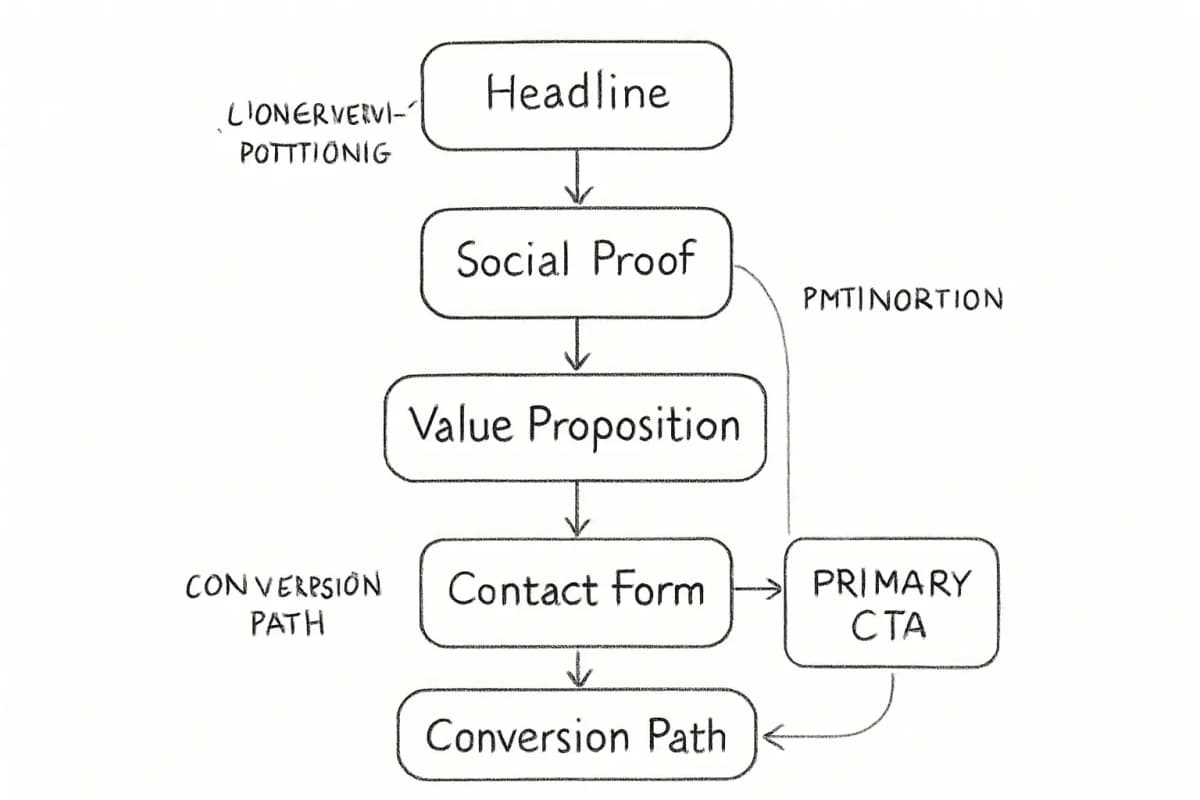
The structural difference is focus. A high-converting email landing page has one goal, one CTA, and zero distractions.
The Anatomy of a High-Converting Email Landing Page
Before looking at specific examples, it helps to understand which elements drive results. These are the components that appear consistently across top-performing pages.
A Headline That Earns Attention in Under 5 Seconds
A landing page headline communicates clear, concise value. With the average visitor bouncing within seconds of arriving, the headline's chief objective is to convince people that staying is worth their time.
The headline also needs to mirror your email's language. Aligning the CTA text from your email with the landing page headline drives 121% higher conversion rates. When subscribers arrive and the headline says something completely different from the email they just read, the psychological continuity breaks and they leave.
A Single, Focused Call to Action
Every high-converting page studied in Unbounce's data set focuses on one action. Campaign Monitor's landing page, for example, centers entirely on a single, actionable goal: "Design Your First HTML Email Now." There is no "Learn More" or "Get Started" vagueness. The copy is so specific and immediate that visitors know exactly what happens when they click through.
Generic CTA copy is a conversion killer. Personalized CTAs convert 202% better than standard ones.
A Short, Purposeful Form
Every additional field in a form drops conversion by 4 to 8%. The sweet spot is 3 to 4 fields for B2B and 1 to 2 fields for ecommerce email capture. Most teams ask for far more than they need at the point of first contact.
Social Proof at the Right Moment
Smart landing pages build trust through layered social proof that feels authentic and relevant. According to HubSpot, including social proof below a landing page CTA can increase its conversion rate by 68%.
WikiJobs learned from A/B testing that a few lines of testimonials make a measurable difference: a product landing page with three small testimonials earned 34% more purchases than a similar version without them.
Fast Load Speed
Per WordStream and HubSpot data covering 2.1 million landing page sessions, each one-second delay beyond the 2.5-second Largest Contentful Paint threshold reduces conversions by approximately 7%. Pages loading in under 1.5 seconds convert 2.4x better than pages loading in 4 seconds.
6 Email Marketing Landing Page Examples Worth Studying
1. The Lead Magnet Page (Content Upgrade)
This is the most common format for B2B and SaaS email campaigns. An email promotes a free guide, report, or template. The landing page delivers on that promise with minimal friction.
What the best examples get right:
- The headline repeats the exact offer named in the email subject line
- A visual of the resource (ebook cover, screenshot) appears above the fold
- The form asks for a name and email only
- A single CTA button uses specific language like "Send Me the Guide" rather than "Submit"
Visitors are unlikely to give away their email address unless they feel they are receiving something valuable in return. The offer might be an exclusive ebook, a discount code, or access to premium content.
2. The Discount or Promotional Page (Ecommerce)
Ecommerce campaigns live and die by these pages. A subscriber gets an email with "20% off today only." They click. The landing page better show that exact discount, immediately.
Any offer or discount promoted in your email should be front and center on the landing page. Burying the promo code below the fold or making subscribers hunt for it destroys the conversion momentum built in the email.
Netflix demonstrates this principle well. One of the best features of Netflix's landing page is that it is simple but contains a lot of information for the viewer. It could have easily been a long-form landing page, but the designers chose to make it a simple three-step journey. That simplicity reduces cognitive load and drives action.
For deeper strategy on converting ecommerce email subscribers, see Ecommerce Email Marketing Tips: 8 Strategies for Higher ROI.
3. The Webinar Registration Page
Webinar registration pages average around 22% conversion rates, with top performers reaching 50 to 60%. The email drives urgency; the landing page closes it.
The strongest webinar landing pages feature:
- A clear date, time, and topic statement above the fold
- A short speaker bio with a photo to build credibility
- A one-field form (email only) or a two-field form (name plus email)
- Social proof showing how many people have registered or attended previous sessions
4. The Free Trial Page (SaaS)
Free trial sign-up pages average 5 to 15% conversion rates. The gap between floor and ceiling is mostly explained by how well the page handles objections.
The best SaaS free trial pages from email campaigns:
- Remove navigation entirely to eliminate escape routes
- Address the top three objections (cost, setup time, commitment) with short bullets
- Include social proof from companies the subscriber would recognize
- Use a CTA that describes the outcome, not the action ("Start Building for Free" beats "Sign Up")
5. The Newsletter Subscription Page
Newsletter subscription pages perform at 10 to 20% conversion rates on average, with top performers reaching 30 to 40% through exclusivity and transparency.
The pattern that drives top performance: the page tells subscribers precisely what they will receive and how often. Vague promises like "stay updated" underperform specific ones like "Get one actionable email strategy every Tuesday."
The best newsletter landing pages also show a sample issue. Letting people preview the content before subscribing removes uncertainty and builds confidence.
6. The Event or Product Launch Page
These pages are time-sensitive and benefit from urgency signals. A countdown timer, limited seat count, or "early access" framing can meaningfully increase conversions when the email has already created desire.
Events and entertainment landing pages tend toward 12.3% median conversion rates, making this one of the stronger categories when executed well.
For a full playbook on this format, see Event Email Marketing Strategy: Complete Guide.
Message Match: The Most Overlooked Conversion Driver
Message match refers to the consistency between what your email promises and what your landing page delivers. It is the highest-leverage, lowest-cost improvement most teams can make.
Landing page conversion rate is a function of three variables: traffic quality, message match, and offer relevance. Most optimization advice focuses on the page in isolation. But traffic quality and message match often have more impact than page design.
Practically, message match means:
- The headline on your landing page mirrors the subject line or CTA of your email
- The visual style and color palette feel like a continuation of the email
- The offer described in the email is the first thing visible on the page
A visitor who clicked "Save 40% this quarter" should land on a page about savings. If they land on a page about enterprise features, the expectation breaks.
To apply this across segmented campaigns, match each email segment to its own dedicated landing page. Sending all your subscribers to the same generic page when your emails are personalized is a fundamental mismatch. For building that kind of segmentation, Email List Segmentation Strategies That Boost ROI by 760% is a strong starting point.
Copy and Readability: The Data Most Teams Ignore
Landing pages written at a 5th to 7th grade reading level convert at 11.1%, which is more than double the 5.3% rate for professional-level writing. There is a strong correlation between reading difficulty level and conversion rates. The easier your copy is to read, the more likely it is to convert at an industry-agnostic level.
This is not about dumbing down your content. It is about removing friction. Long sentences, passive voice, and jargon force the reader to work harder, and working harder means stopping.
Practical copy rules for email landing pages:
- Keep sentences under 20 words
- Use bullet points to present benefits, not paragraphs
- Write the headline in the second person: "You'll get..." rather than "Our platform provides..."
- Keep total copy under 500 words unless the product requires more explanation
Mobile Optimization Is Non-Negotiable
Mobile now accounts for 65% of landing page traffic but converts at roughly 58% of the desktop rate. That gap is not inevitable. It reflects poor mobile execution.
Among top landing pages, 86% have been optimized for mobile. If your email subscribers are opening on mobile (which most are) and your landing page renders poorly on a phone, you are losing conversions at the last possible moment.
Mobile-specific fixes that move the needle:
- Place the CTA button within thumb reach, not buried below a wall of text
- Use a single-column layout
- Ensure form fields are large enough to tap without zooming
- Test load time on a 4G connection, not just broadband
70% of email recipients will delete an email immediately if it is not mobile friendly. That same expectation carries directly to the landing page.
Testing: Where Good Pages Become Great Ones
Testing and targeting can increase landing page conversion rates by up to 300%. Most teams test infrequently and draw conclusions too quickly.
Only 17% of marketers A/B test their landing pages, yet testing produces 37% average conversion gains. The opportunity is significant, and the barrier to entry is low with most landing page tools offering built-in A/B testing.
What to test in order of expected impact:
- Headline and subheadline
- CTA button copy
- Form length
- Social proof placement
- Hero image or video
- Page layout (above vs. below the fold structure)
Start with landing page tests to identify the best-performing variants and use those insights to refine your email copy for maximum impact. The feedback loop between email and landing page goes in both directions.
To track what is working across your full email funnel, see Email Marketing Analytics Best Practices.
Frequently Asked Questions
What is an email marketing landing page?
An email landing page is a standalone web page that uses persuasive elements like testimonials, contact forms, and benefit-oriented copy to convince visitors to convert on an offer. It is reached after a prospect clicks on a link within an email. Unlike a homepage, it has one purpose and one CTA.
What is a good conversion rate for an email landing page?
Visitors driven to landing pages by email have the highest average conversion rate of any traffic source, at 19.3%. However, the average email landing page converts at a rate of 2.35%, but the top 25% of sites convert at 5.31%, with the top 10% converting at 11.45% and up. Use your own baseline and traffic source mix to set a realistic target.
How many CTAs should an email landing page have?
One. A focused email landing page should contain a single CTA tied to a single conversion goal. Multiple CTAs split attention and dilute conversion intent. If you need to promote multiple offers, build separate landing pages for each.
How do I improve a landing page that is getting clicks but not converting?
Start with message match. Check whether the headline and offer on the page align with the email that drove the click. Then audit your form length, CTA copy, and mobile rendering. The most common reasons for low conversion are poor message match between the email and the page, trust signals buried below the fold, too many form fields, slow page load times over 3 seconds, and sending mixed-intent traffic to a single page.